Beyond the Buzzwords: 5 Terms Defining Next-Generation Utilities [2026 Update]
Two years ago, "digitization" was an initiative.
Today, it’s your baseline for operational excellence.
For utility executives, the shift from legacy hardware to an intentionally connected system is the only way to manage the increasing complexity of the modern grid.
To lead your organization through this transition, you must master these five pillars of the current energy movement.
1. Industry 4.0 & The Smart Grid
Often called the "Fourth Industrial Revolution," Industry 4.0 is the convergence of physical infrastructure and cyber-physical systems. In your world, this is regularly referred to as the Smart Grid.
It moves you beyond simple connectivity into the realm of predictive analytics. By leveraging AI and big data, your system can quickly identify a weak point like a failing transformer weeks before it blows, allowing you to schedule maintenance on your terms.
In fact, Southern Company recently deployed this capability during the recent ice storm that swept through the southeast in January 2026. "Our AI models came out better than we expected," remarked Southern Company CEO Chris Womack.
Check out the conversation about how Southern Company's technology better prepared their team for the storm.
2. Digital Transformation
It’s clear that digital transformation is the fundamental overhaul of your utility’s operational model and what enables a Smart Grid deployment. For your management team, it means moving away from paper-based silos and integrating real-time data (and even LLMs) into multiple - if not all - facets of your organization. A quick example that our clients have shared: AI models can be used to instantly query decades of maintenance manuals and operating procedures for faster, more accurate knowledge transfer and just-in-time SOPs.
Digital transformation is a calculated cultural shift that ensures your organization remains agile enough to manage fluctuating load profiles, as well as prepare for and execute against new demands.
3. Grid Resilience
While reliability measures how often the lights stay on, Grid Resilience measures how quickly your system recovers when they go out. Digital transformation is the primary engine behind a resilient grid. Automated switching and self-healing networks can isolate faults in seconds, minimizing the impact of extreme weather events and protecting your duration (SAIDI) and frequency (SAIFI) metrics.
For more on SAIFI and SAIDI, check out this video posted by Initial Learn With Me:
4. IIoT (Industrial Internet of Things)
In the utility sector, IIoT is the nervous system of your infrastructure. It is the deployment of smart sensor systems that allow your physical assets to "talk" to your team.
Instead of waiting for an operator to notice a dip in performance or a ratepayer to report an outage, IIoT allows your assets to alert you to a fault before the lights go out. By connecting equipment to a unified digital network, you gain the real-time visibility needed to reduce O&M costs and improve response times.
5. Unified Namespace (UNS)
The biggest hurdle to a digital utility is fragmented data. A Unified Namespace acts as your "single source of truth," providing a common ground where all data is standardized and shared. It ensures that your GIS, SCADA, and AMI systems all speak the same language in real-time.
Not limited to just utility and energy facilities, a UNS is a powerful, modern tool that uses Industry 4.0 technology for significantly better monitoring and managing of your infrastructure and operations.
A Unified Namespace grants connection across your systems, and grants your team better visibility, yielding optimized performance and faster resolution across the entire organization.
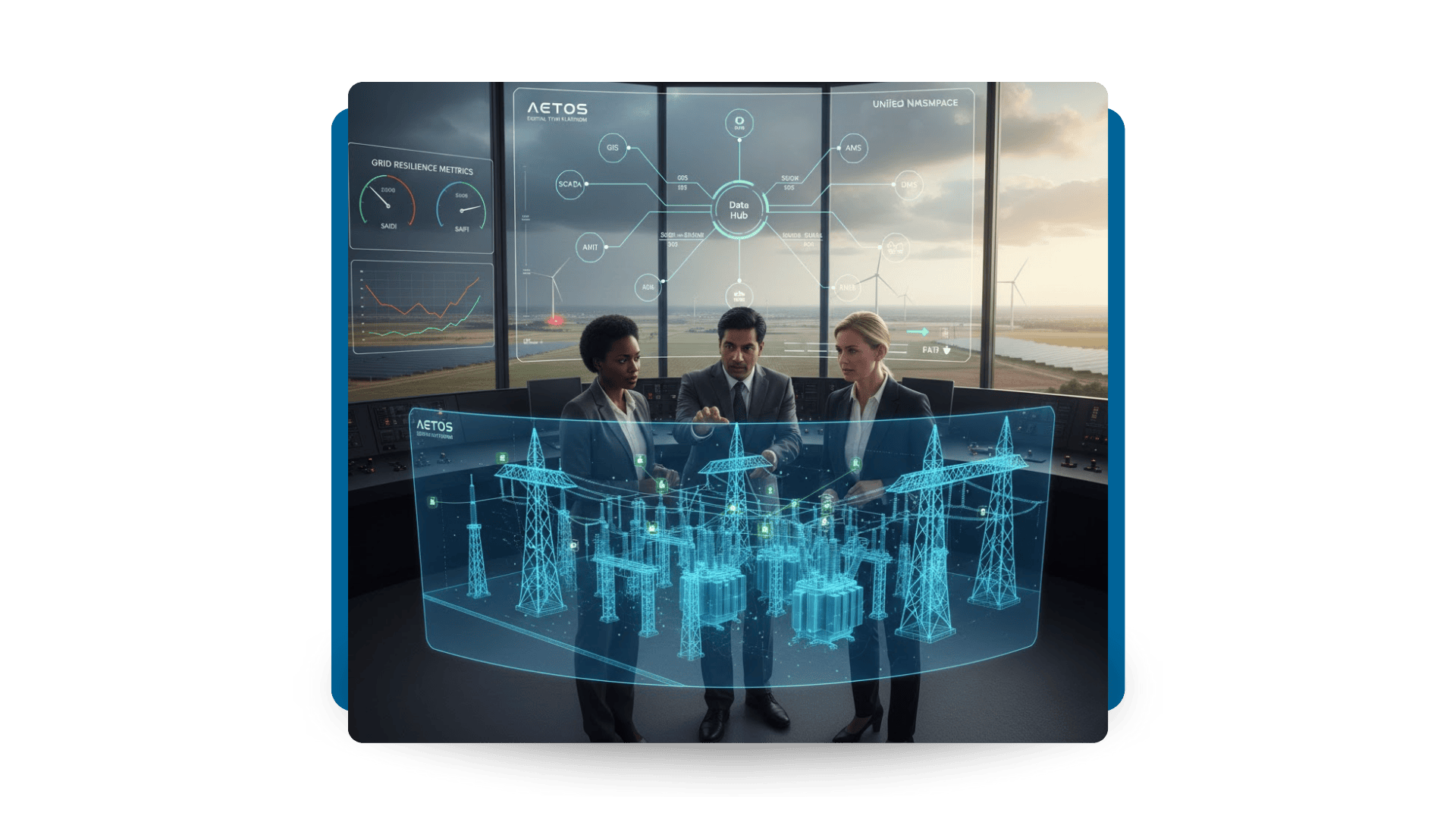
Visualizing Your Digital Journey
Data is only useful if your team can interpret it quickly. Aetos turns the abstract data from your UNS and IIoT sensors into a visual map of your actual facility.
We’ve moved beyond abstract concepts to provide a tangible leap in operational efficiency. Aetos combines 3D scanning, visual asset management, and IoT integrations to create a Digital Twin of your infrastructure.
Imagine your team virtually navigating a high-voltage substation or a complex generation facility from their desktops. Every component is an interactive digital asset. By syncing real-time IIoT data with these 3D models, you can:
- Perform remote inspections without putting boots on the ground in hazardous areas.
- Train technicians in a safe, high-fidelity virtual environment.
- Access maintenance logs and real-time performance metrics with a single click.
If you’d like a closer look at how we’re doing this – and how we’re supporting our customers through their digital transformation journey – schedule a free consultation with one of our subject matter experts today.
Digital transformation is no longer optional for grid reliability. Mastering these 5 pillars – from the Smart Grid all the way to the Unified Namespace – is the key to reducing SAIDI/SAIFI scores and optimizing your O&M spend in 2026.


